Most people's idea of a "fitting" is trying on a finished suit and checking the mirror. With bespoke tailoring, that's only the last of several. The fitting process is where a garment goes from cloth and measurements to something that moves the way you move - and it's the part that off-the-rack and made-to-measure simply can't replicate.
Why one fitting was never going to be enough
A bespoke pattern is cut specifically for your body, but bodies aren't symmetrical, posture varies, and cloth behaves differently once it's actually being worn rather than measured flat on a table. The first fitting - usually at the baste stage, before any lining or finishing - exists to catch all of this early, while changes are still simple to make.
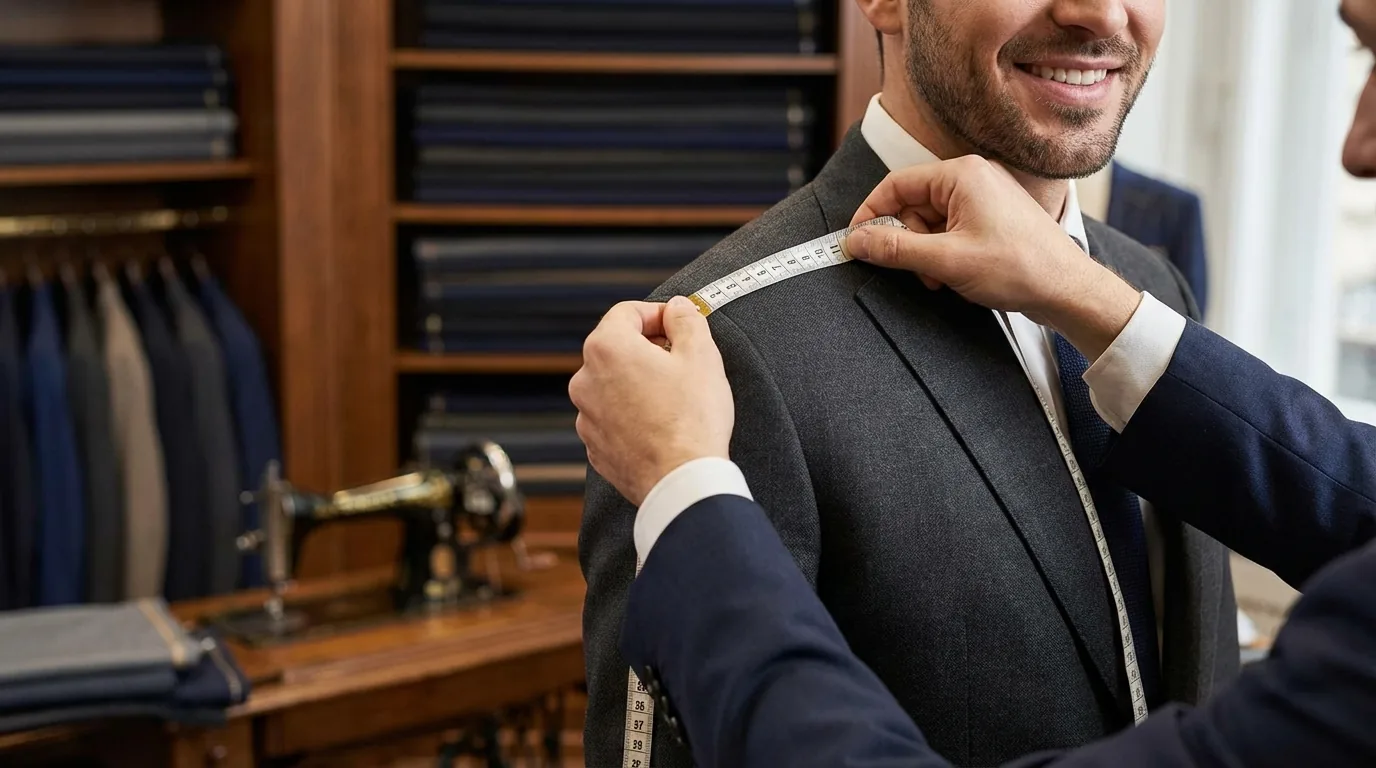
Your tailor will check balance across the shoulders, how the collar sits against your neck, where the jacket breaks at the waist, and how the sleeve hangs when your arm is at rest versus in motion. None of this can be assessed from a tape measure alone.
What changes between fittings
Each fitting typically resolves a smaller and smaller list of adjustments. By the second fitting, the canvas and padding are in place and the garment starts to take its true shape. Small things - a quarter inch off a sleeve, easing a shoulder seam - make a disproportionate difference to how the finished piece sits.
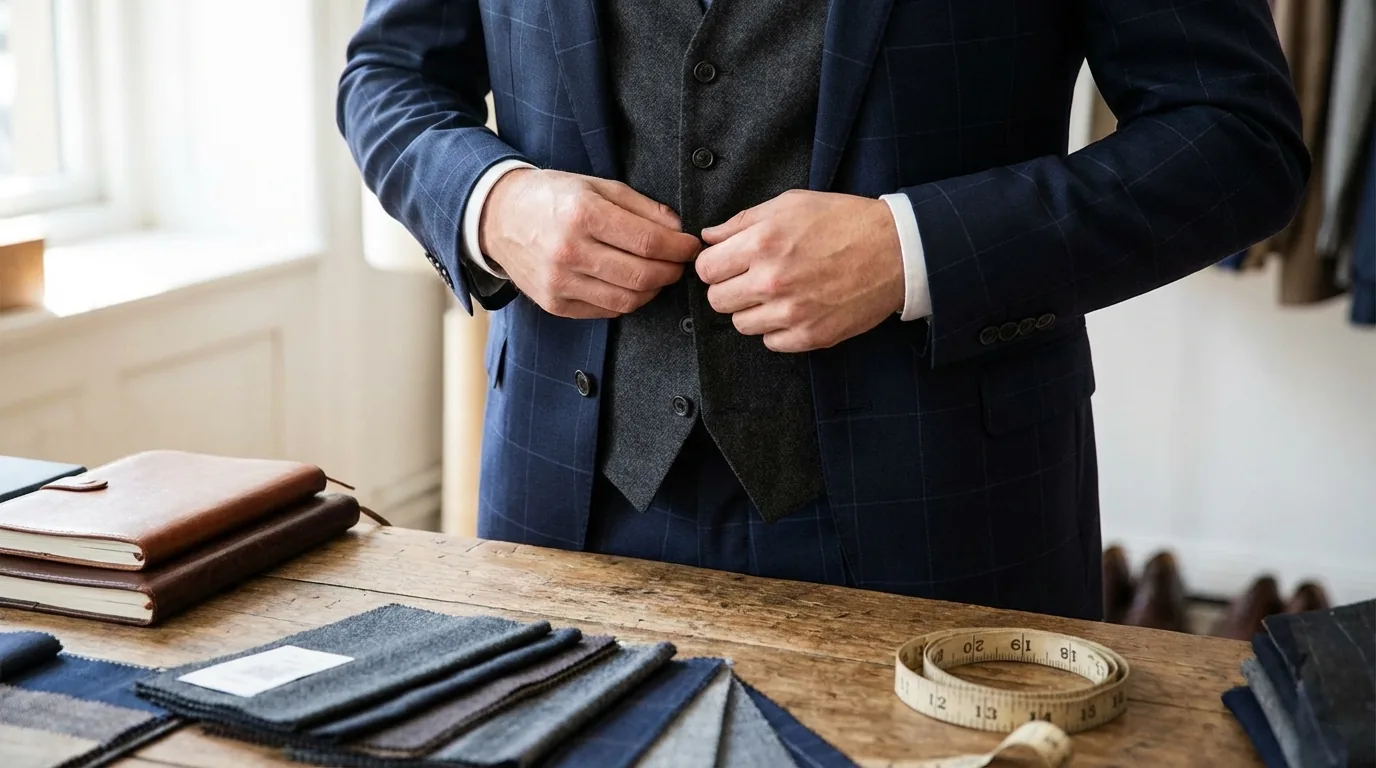
This is also the stage where you'll notice the garment starting to move with you rather than against you. A well-fitted jacket shouldn't restrict your arms when reaching forward, and trousers shouldn't pull or bunch when you sit.
The final fitting
By the time you reach the final fitting, adjustments are usually cosmetic rather than structural - button stance, finishing details, a final press. It's less about fixing problems and more about confirming that everything resolved in the earlier stages has translated into the finished garment exactly as intended. You can see how this fits into the wider process on our step-by-step bespoke journey.
The baste fitting explained
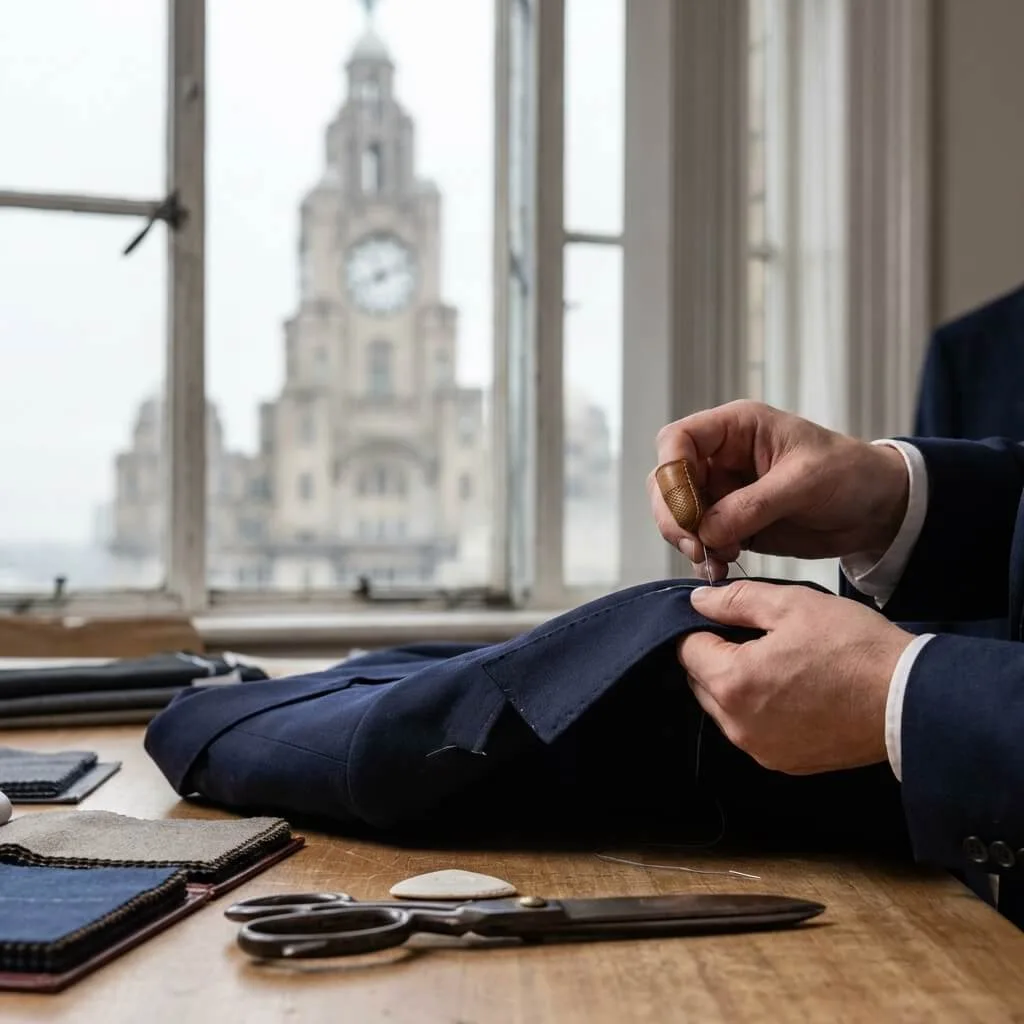
The first fitting is often called the baste, or "skeleton baste", and to an untrained eye the garment can look alarming - loosely tacked together with white basting thread, sometimes with raw edges, chalk marks across the cloth, and only one sleeve attached. This is deliberate. At this stage your tailor wants a garment that can be taken apart and reassembled easily, because almost everything is still open to change. The pattern that was cut from your measurements is being tested against your actual body for the first time, and the cloth is finally hanging under its own weight rather than lying flat.
What your tailor is really reading at the baste is balance - whether the front and back of the jacket hang in equilibrium, whether one shoulder sits lower than the other (almost everyone's does), and how your natural posture affects the way the collar meets your neck. These are the structural decisions that are nearly impossible to correct later, which is exactly why they are addressed first, while the garment is still little more than a well-considered draft.
Why your body is the moving target
Part of what makes bespoke fitting an art rather than a formula is that no body is static. Posture shifts depending on whether you stand at ease or hold yourself formally, one arm is usually slightly longer or set further forward than the other, and the way you carry your weight changes how cloth drapes across the chest and back. A good tailor watches how you stand naturally when you are not thinking about it, then cuts for the real you rather than an idealised, symmetrical version.
This is also why bringing the shoes and shirt you intend to wear with the finished suit genuinely matters. Trouser length is set to break correctly over a specific shoe, and collar height is judged against the shirt that will sit beneath it. Small contextual details like these are the difference between a suit that fits on the day of collection and one that fits every time you wear it.
How many fittings should you expect?
For a first commission with a new client, two to three fittings is typical - the baste, a second forward fitting once the garment has taken shape, and a final fitting to confirm the finished piece. Once your tailor has an established pattern that has already been proven on your body, subsequent garments often need fewer fittings, because the hardest work - understanding how you are built and how you move - has already been done. That accumulated knowledge is one of the quiet advantages of returning to the same tailor over time.
It's a slower process than picking a suit off a rail, but it's the reason a bespoke garment fits in a way that's difficult to put into words until you've worn one.